

AI News

A Coding Guide to NVIDIA’s Tile-Based GPU Programming: From cuTile and Triton Kernels to Flash Attention

In this tutorial, we explore NVIDIA tile-based GPU programming with TileGym, building a Colab workflow that runs across different hardware. We probe the CUDA environment, try the real cuTile backend, and fall back to Triton when standard Colab GPUs lack the cuTile stack. We learn the core tile idea: operate on whole data tiles instead of single threads, then load, compute, and store them. We implement vector addition, fused GELU, row-wise softmax, tiled matrix multiplication, and flash attention, checking each against PyTorch.

The post A Coding Guide to NVIDIA’s Tile-Based GPU Programming: From cuTile and Triton Kernels to Flash Attention appeared first on MarkTechPost.

Read More »

Mira Murati’s Thinking Machines Lab Makes The Technical Case For Human-Centered AI Built On Customizable Model Weights

Thinking Machines Lab published “The Future Worth Building Is Human.” The essay frames human participation, model ownership, and decentralized alignment as technical challenges. It ties them to interaction models and Tinker’s LoRA fine-tuning, where teams train and keep their own model weights.

The post Mira Murati’s Thinking Machines Lab Makes The Technical Case For Human-Centered AI Built On Customizable Model Weights appeared first on MarkTechPost.

Read More »

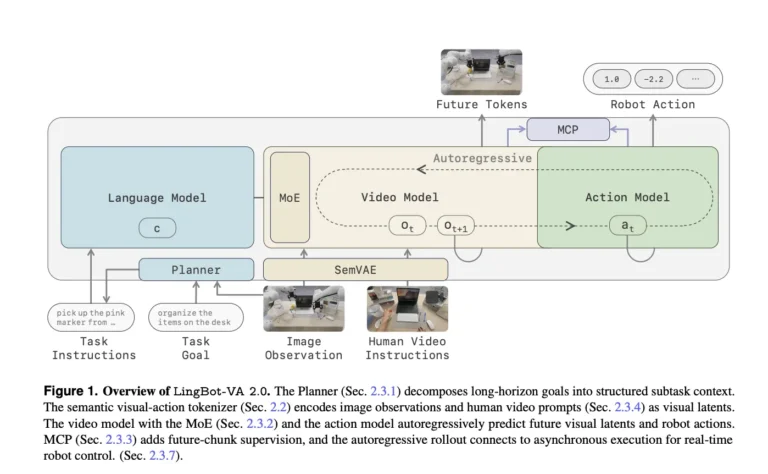
Ant Group’s Robbyant Unveils LingBot-VA 2.0: A Causal Video-Action Model Built Natively for Physical AI

Ant Group’s Robbyant has released the LingBot-VA 2.0 technical report — a Physical AI video-action foundation model built from scratch for embodiment rather than fine-tuned from a video generator. It predicts future states ahead of execution through Foresight Reasoning, re-grounds on every real observation, and reaches 225 Hz asynchronous control. We break down the causal DiT, the sparse-MoE video stream, the semantic visual-action tokenizer, and where the paper’s own numbers don’t line up.

The post Ant Group’s Robbyant Unveils LingBot-VA 2.0: A Causal Video-Action Model Built Natively for Physical AI appeared first on MarkTechPost.

Read More »

Apple sues OpenAI for allegedly stealing hardware secrets

Apple has sued OpenAI, alleging that engineers stole Apple secrets to advance the AI startup’s hardware plans. In its complaint, Apple says it uncovered “a pattern of theft of Apple’s trade secrets by OpenAI employees who were formerly at Apple.” In addition to OpenAI, the lawsuit also names IO Products – Jony Ive’s hardware startup, […]

Read More »

How to Build a T4-Friendly Autonomous Data Science Agent with DeepAnalyze-8B, Sandboxed Code Execution, and Iterative Analysis

We build an autonomous data science agent around DeepAnalyze-8B and run it end to end. We prepare a stable Colab runtime, install the machine-learning dependencies, and load the tokenizer and model in 4-bit mode to fit limited GPU memory. We add a sandboxed execution environment that lets the model generate Python, run it safely, observe results, and continue in an agentic loop. We then hand the agent a multi-file e-commerce workspace and let it clean, join, analyze, visualize, and summarize the data as an analyst-grade report.

The post How to Build a T4-Friendly Autonomous Data Science Agent with DeepAnalyze-8B, Sandboxed Code Execution, and Iterative Analysis appeared first on MarkTechPost.

Read More »

Kyutai Releases MuScriptor: An Open-Weight Decoder-Only Transformer for Multi-Instrument Music Transcription to MIDI

MuScriptor is an open-weight, decoder-only Transformer from Kyutai and Mirelo. Trained on 170k real recordings plus 1.45M synthetic MIDIs, it transcribes full multi-instrument mixes into MIDI. The article covers its three-stage pipeline, benchmarks against YourMT3+, instrument conditioning, and setup, with an interactive explainer demo.

The post Kyutai Releases MuScriptor: An Open-Weight Decoder-Only Transformer for Multi-Instrument Music Transcription to MIDI appeared first on MarkTechPost.

Read More »

Would you host part of an AI data center in your home?

A solar and home energy storage company is expanding into AI data centers, but not by building one – instead, it’s offering to pay its customers to put its compute units in their homes. Sunrun is launching a pilot program for a new “distributed AI compute” program that will “place numerous compute nodes in homes […]

Read More »

Hugging Face’s CEO on why companies are done renting their AI

Open source AI is booming, according to Hugging Face CEO Clem Delangue. The company has grown into something like a GitHub for AI in recent years, where AI builders can share and download open models and datasets, now used by roughly half the Fortune 500. Delangue has seen the same story play out again and again: companies start […]

Read More »

Meet LingBot-World-Infinity: An Open Causal World Model With An Agentic Harness

Robbyant, Ant Group’s embodied-intelligence unit, has released LingBot-World-Infinity (LingBot-World 2.0). It is a 14B causal video generation model that behaves as an interactive world simulator. The core idea is the Mixture of Bidirectional and Autoregressive (MoBA) attention mask, paired with distribution matching distillation applied over long self-rollout trajectories. Together they target long-horizon drift, the failure mode that smears textures and warps geometry in most interactive world models. A Director-Pilot agentic harness wraps the generator, where a VLM proposes events and the Diffusion Transformer renders them. The report shows a single 60-minute uninterrupted session covering 20 scenarios. But the release is thinner than the paper: one checkpoint, a 480P reference script, no deployment code, no quantitative benchmarks, and a non-commercial CC BY-NC-SA 4.0 license.

The post Meet LingBot-World-Infinity: An Open Causal World Model With An Agentic Harness appeared first on MarkTechPost.

Read More »