AI News

Validating Distributed LLM Serving Benchmarks with NVIDIA srt-slurm, SLURM Recipes, Parameter Sweeps, and Pareto Analysis

In this tutorial, we explore NVIDIA’s srt-slurm framework and learn how we use srtctl to convert declarative YAML configurations into reproducible SLURM benchmark workflows for distributed LLM serving. We set up the project in Google Colab, inspect its internal architecture, define a cluster configuration, dry-run built-in and custom recipes, and model a disaggregated prefill-and-decode deployment […]

The post Validating Distributed LLM Serving Benchmarks with NVIDIA srt-slurm, SLURM Recipes, Parameter Sweeps, and Pareto Analysis appeared first on MarkTechPost.

Read More »

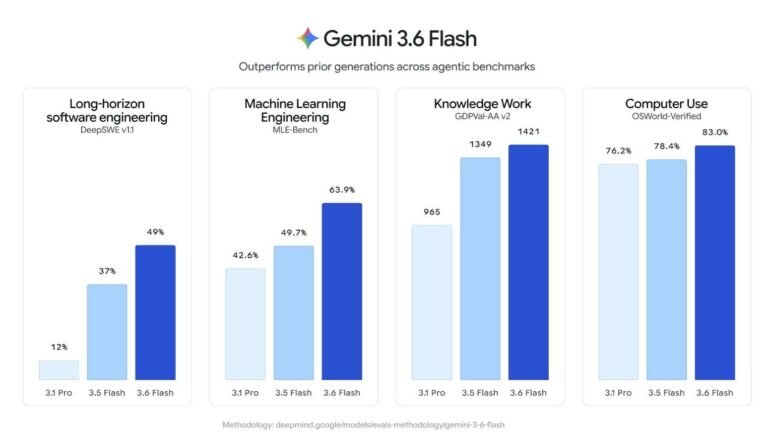
Google Releases Gemini 3.6 Flash, 3.5 Flash-Lite, and 3.5 Flash Cyber: A Cheaper, More Token-Efficient Flash Tier Built for Agentic Workloads

Google released Gemini 3.6 Flash, 3.5 Flash-Lite, and 3.5 Flash Cyber on July 21, 2026. The Flash tier gets cheaper and more token-efficient, with 3.6 Flash cutting output tokens 17% and dropping its output price to $7.50 per 1M. Flash-Lite runs at 350 tokens/sec, while gated Flash Cyber powers CodeMender for vulnerability finding. The flagship 3.5 Pro remains delayed.

The post Google Releases Gemini 3.6 Flash, 3.5 Flash-Lite, and 3.5 Flash Cyber: A Cheaper, More Token-Efficient Flash Tier Built for Agentic Workloads appeared first on MarkTechPost.

Read More »

America needs to stop getting shocked by Chinese AI

Last week, two Chinese AI companies unveiled models they say can credibly compete with the best systems from OpenAI and Anthropic. The response was swift and predictable. Markets wobbled, commentators declared Silicon Valley shooketh, and policymakers reached for the familiar language of arms races and wake-up calls. In one headline, The Associated Press said a […]

Read More »

Halliday’s latest smart glasses feature a much-improved display

I first slipped on Halliday’s original smart glasses at CES 2025. I was not a fan. The glasses had a tiny, movable display window embedded into the frame that was incredibly finicky to see, and my 30-minute demo left me with achy eyeballs. It was an interesting concept with terrible execution, especially compared to the […]

Read More »

Google launches a cheaper alternative to large AI security models like Mythos

Google is launching Gemini 3.6 Flash alongside a new security model dedicated to quickly finding and patching security vulnerabilities. In a blog post on Tuesday, Google describes Gemini 3.5 Flash Cyber as a “cost-efficient and highly capable alternative” to larger, more expensive AI systems, such as the one offered by Anthropic’s Mythos. The cybersecurity model […]

Read More »

Anthropic’s $1.5 billion book piracy settlement approved by judge

A federal judge has signed off on Anthropic’s $1.5 billion class action settlement with authors who accused the company of training its AI models on copyrighted books, as reported earlier by Reuters. In an order on Monday, Judge Araceli Martínez-Olguín writes that the settlement will provide “meaningful relief,” offering authors around $3,000 for each book […]

Read More »

Advancing next-gen AI with materials science innovation

The conversation about AI often centers on algorithms, computing power, or huge investments in new semiconductor fabrication plants and hyperscale data centers. But beneath each of these advances is another layer of innovation that makes them possible: advanced materials. Every new generation of AI technology demands more processing power, more memory, greater energy efficiency, and…

Read More »

Chinese open-weight models are cheap. Washington is deciding what that costs.

Enterprises evaluating Chinese open-weight models this month face a question that has nothing to do with benchmarks: whether using one will still be straightforward in a year. Moonshot AI’s Kimi K3 arrived on July 16 as the largest open-weight model yet released, and within days it had reopened a policy argument in Washington that had […]

The post Chinese open-weight models are cheap. Washington is deciding what that costs. appeared first on AI News.

Read More »

Bristol Myers Squibb buys Nvidia AI system for drug discovery

Bristol Myers Squibb is purchasing an Nvidia DGX SuperPOD built on the chipmaker’s Vera Rubin architecture to support artificial intelligence use across its drug discovery and development operations. The pharmaceutical company said it will be the first life sciences group to acquire a DGX SuperPOD based on Vera Rubin. Nvidia introduced the architecture earlier this […]

The post Bristol Myers Squibb buys Nvidia AI system for drug discovery appeared first on AI News.

Read More »

NVIDIA Releases Cosmos 3 Edge: A 4B-Parameter Open World Model That Reasons and Generates Robot Actions On-Device

NVIDIA has released Cosmos 3 Edge, a 4-billion-parameter open world model built to run on-device. It helps robots and vision AI agents understand surroundings, reason in real time, and generate robot actions locally. The Cosmos 3 family included Cosmos 3 Nano (16B) and Cosmos 3 Super (64B) shipped on May 31, 2026 at GTC Taipei. […]

The post NVIDIA Releases Cosmos 3 Edge: A 4B-Parameter Open World Model That Reasons and Generates Robot Actions On-Device appeared first on MarkTechPost.

Read More »

Meta Open-Sources Astryx: An Agent-Ready React Design System With 150+ Accessible Components, Seven Themes, and a CLI

Meta has open-sourced Astryx, the React and StyleX design system it ran internally for eight years across 13,000+ apps. It ships 150+ accessible components, seven themes, dark mode, templates, and an agent-ready CLI under MIT — with React 19+ required.

The post Meta Open-Sources Astryx: An Agent-Ready React Design System With 150+ Accessible Components, Seven Themes, and a CLI appeared first on MarkTechPost.

Read More »