
AI News

Physical AI is having its moment–and everyone wants a piece of it

There is a particular kind of momentum in the technology industry that announces itself not through a single breakthrough, but through the simultaneous convergence of many. Physical AI is having that moment right now–and paying attention to where it is coming from, and why, tells you more than any single product launch can. The term […]

The post Physical AI is having its moment–and everyone wants a piece of it appeared first on AI News.

Read More »

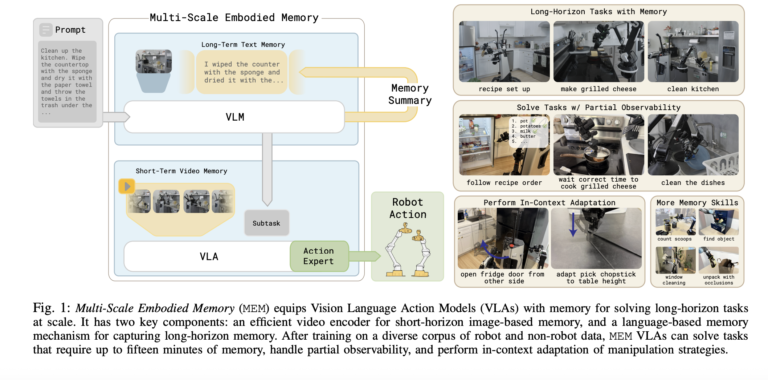
Physical Intelligence Team Unveils MEM for Robots: A Multi-Scale Memory System Giving Gemma 3-4B VLAs 15-Minute Context for Complex Tasks

Current end-to-end robotic policies, specifically Vision-Language-Action (VLA) models, typically operate on a single observation or a very short history. This ‘lack of memory’ makes long-horizon tasks, such as cleaning a kitchen or following a complex recipe, computationally intractable or prone to failure. To address this, researchers from Physical Intelligence, Stanford, UC Berkeley, and MIT have […]

The post Physical Intelligence Team Unveils MEM for Robots: A Multi-Scale Memory System Giving Gemma 3-4B VLAs 15-Minute Context for Complex Tasks appeared first on MarkTechPost.

Read More »

Inside the secret meeting that led to the AI political resistance

In early January, a group of 90 or so political, community and thought leaders gathered in a New Orleans Marriott for a secret conference on artificial intelligence – so secret, in fact, that no one knew who else had been invited until they walked into the room. Church leaders and conservative academics were sitting next […]

Read More »

Physical AI adoption boosts customer service ROI

The adoption of physical AI drives ROI in frontline customer service by merging digital intelligence with human-like physical interaction. As businesses navigate shrinking labour pools, they are finding that simply automating routine workflows is no longer enough. A new partnership between KDDI and AVITA demonstrates how companies can address complex operational gaps through humanoid deployment. […]

The post Physical AI adoption boosts customer service ROI appeared first on AI News.

Read More »

Best AI security solutions 2026: Top enterprise platforms compared

Artificial intelligence is no longer just powering defensive cybersecurity tools, it is reshaping the entire threat landscape. AI is accelerating reconnaissance, improving the realism of phishing, automating malware mutation, and enabling adaptive attack techniques. At the same time, enterprises are embedding AI agents, copilots, and generative AI tools into everyday workflows. That dual dynamic has […]

The post Best AI security solutions 2026: Top enterprise platforms compared appeared first on AI News.

Read More »

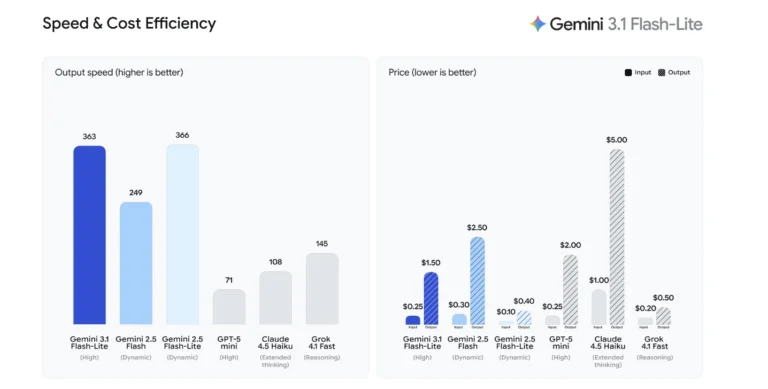
Google Drops Gemini 3.1 Flash-Lite: A Cost-efficient Powerhouse with Adjustable Thinking Levels Designed for High-Scale Production AI

Google has released Gemini 3.1 Flash-Lite, the most cost-efficient entry in the Gemini 3 model series. Designed for ‘intelligence at scale,’ this model is optimized for high-volume tasks where low latency and cost-per-token are the primary engineering constraints. It is currently available in Public Preview via the Gemini API (Google AI Studio) and Vertex AI. […]

The post Google Drops Gemini 3.1 Flash-Lite: A Cost-efficient Powerhouse with Adjustable Thinking Levels Designed for High-Scale Production AI appeared first on MarkTechPost.

Read More »

How to Build a Stable and Efficient QLoRA Fine-Tuning Pipeline Using Unsloth for Large Language Models

In this tutorial, we demonstrate how to efficiently fine-tune a large language model using Unsloth and QLoRA. We focus on building a stable, end-to-end supervised fine-tuning pipeline that handles common Colab issues such as GPU detection failures, runtime crashes, and library incompatibilities. By carefully controlling the environment, model configuration, and training loop, we show how […]

The post How to Build a Stable and Efficient QLoRA Fine-Tuning Pipeline Using Unsloth for Large Language Models appeared first on MarkTechPost.

Read More »

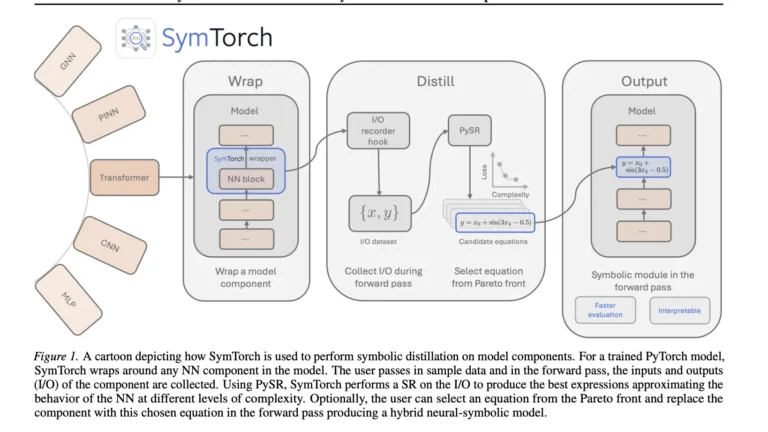
Meet SymTorch: A PyTorch Library that Translates Deep Learning Models into Human-Readable Equations

Can symbolic regression be the key to transforming opaque deep learning models into interpretable, closed-form mathematical equations? or Say you have trained your deep learning model. It works. But do you know what it has actually learned? A team of University of Cambridge researchers propose ‘SymTorch’, a library designed to integrate symbolic regression (SR) into […]

The post Meet SymTorch: A PyTorch Library that Translates Deep Learning Models into Human-Readable Equations appeared first on MarkTechPost.

Read More »

Why is SpaceX going public?

I am excited about the SpaceX IPO for all the reasons investors shouldn’t be. Maybe it’ll be a real marquee moment for Silicon Valley, but I see the potential for a shitshow. After all, more than a decade ago, Musk said that SpaceX going public before going to Mars would be bad for the company. […]

Read More »

How the experts figure out what’s real in the age of deepfakes

In the days that followed the US and Israel’s joint military strike on Iran on Saturday, floods of images and videos that supposedly document the war have appeared online. Some are old or depict unrelated conflicts, are made or manipulated with AI, and in some cases, are actually taken from military-themed video games like War […]

Read More »

AI-Native networks are no longer a 6G promise–MWC 2026 just proved it

AI-native networks have been a recurring talking point at Mobile World Congress for years. What made MWC 2026 in Barcelona different was the evidence. A cascade of announcements from the world’s biggest telecom vendors, chipmakers, and operators didn’t just reiterate the vision for AI-RAN–they delivered field trial results, commercial product launches, open-source toolkits, and a […]

The post AI-Native networks are no longer a 6G promise–MWC 2026 just proved it appeared first on AI News.

Read More »