
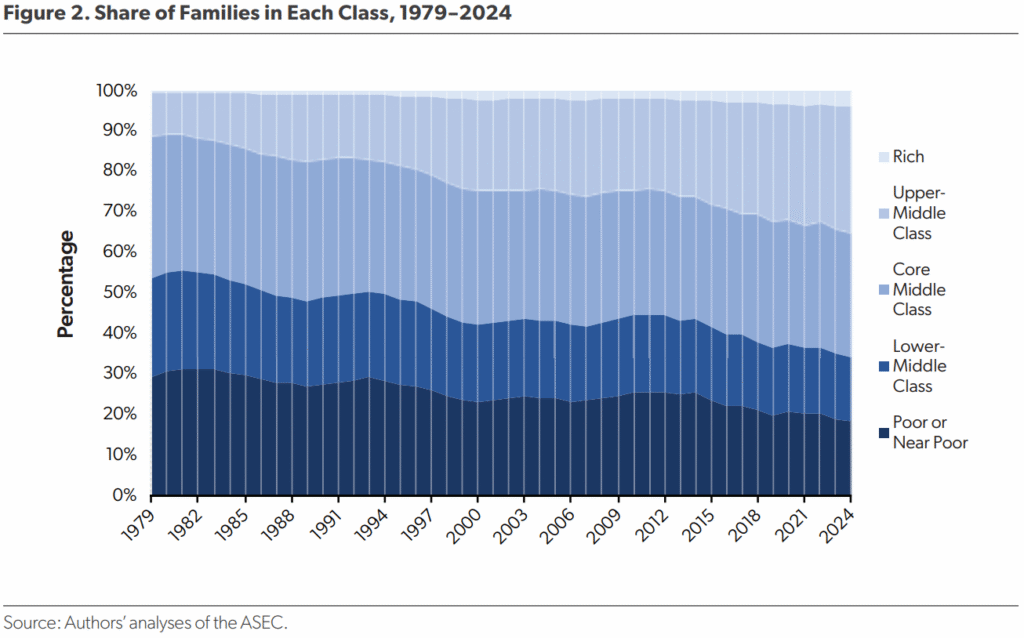
The upper-middle class has tripled, growing from 10% of American families in 1979 to 31% in 2024. According to a January 2026 report from public policy think tank American Enterprise Institute (AEI), for the first time in history, more families now sit above the core middle class than below it.
Who is in the growing middle class?
According to the data, more people are moving from the core middle class into the upper-middle class, largely due to the growth of professional opportunities. “American families up and down the income ladder have seen sizable gains over the past half century,” wrote the report authors.
They cite economic growth, greater professional opportunities for women and a strong safety net as factors that offset the decline of marriages, which traditionally provide stability to families due the potential for dual incomes. In 2024, only about half of adults were married, down from two-thirds in 1950, according to data from USA Facts.
This report uses family income estimates from Census Bureau data, considers incomes between 1979 and 2024 and adjusts for family size. The researchers peg the upper-middle class as households with incomes between roughly five and 15 times the federal poverty line for their family size. For example, this translates to $133,000 to $400,000 annually for a family of three in 2024 dollars.

“For the first time in American history, more families in 2024 were above the core middle class threshold than below it,” wrote the report authors. “If we combine the lower-, core, and upper-middle classes, their share of families has risen from 70% to 78% since 1979.” The AEI authors credit three forces for this movement: economic growth, greater professional opportunities for women and a robust safety net.
It’s worth noting that median hourly wages for women rose 56%-83% since 1979, largely generated through better opportunities, not just more hours. Additionally, the report shows that dual-income professional households largely contributed to upper-middle class growth, alongside the expansion of knowledge work.
However, 35% of families still fall below core middle-class thresholds. The next expansion will depend on who gets access to work. It’s hard to consider future work opportunities without considering the impact of technology. As AI shapes new roles, employers explore internal mobility and skills-based hiring helps employees fit into alternative titles, there is continuing opportunity for HR to shepherd workers into professional opportunities.
‘Fewer families in hardship’
Readers following this story may be confused about conflicting headlines. The AEI authors contrast their findings with Pew Research’s widely cited reports showing a shrinking middle class (61% in 1971 to 51% in 2023) that they describe as “Americans are more apart than before financially.”
AEI argues that’s misleading because Pew names the middle class as those whose income fits between two-thirds and double whatever the middle family’s income is that year. In other words, when rich people get richer, that “middle” number climbs, so fewer families fit the range, even if everyone’s doing better, according to AEI.
“Claims that the middle class is ‘shrinking’—and especially that it has hollowed out—are not helpful for understanding changes in material wellbeing,” write the report authors. “Decrying a shrinking or hollowed-out middle class is just a gloomy way of saying the upper-middle class has boomed and fewer families are in hardship.”
The post How HR can build on American’s upper-middle class boom appeared first on HR Executive.
This article was originally published on HR Executive. Click below to read the complete article.