
European workers and HR leaders may feel anxious about AI at work, but new research from the European Central Bank suggests a more positive story leading into the continent’s biggest HR tech gathering in Amsterdam.
ECB economists Laura Lebastard and David Sondermann published a report based on survey data from more than 5,000 euro-area firms, and found that, for now, AI is a job creator.
AI and hiring in Europe
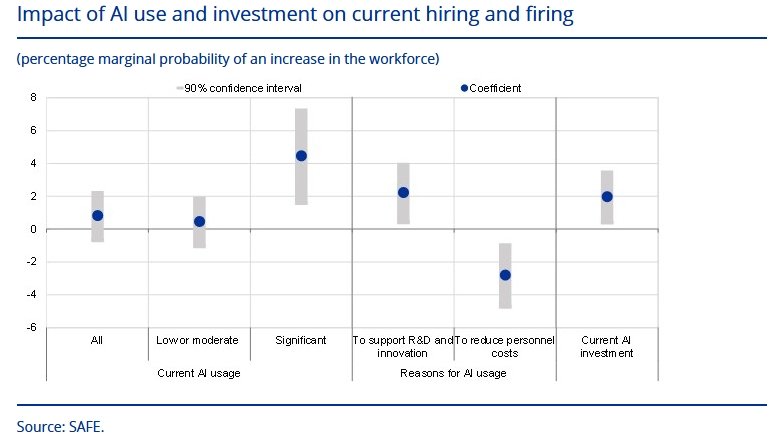
The research discovered that AI-intensive firms are 4% more likely to hire and nearly 2% more likely to grow headcount than firms that aren’t investing intentionally in artificial intelligence. The economists reveal that firms planning AI investment still expect to add staff in the future.
But not all AI investments are equal. The ECB found that firms applying AI to R&D-focused work are driving the hiring growth, while those using AI to cut costs see negative hiring trends and layoff upticks. The report’s key HR diagnostic advises leaders to get clear about what they want AI to do, rather than a generalized adoption approach. Reassuringly, the researchers found that only 15% cite cost reduction as their AI rationale, suggesting that largely, organizations in Europe are positioning AI as a problem-solving advancement rather than a way to trim operational spend.
Read more: European employers risk €35 million by overlooking AI compliance
The report found that two-thirds of firms use AI, yet only one quarter invest in it, leaving employees to patch together the most accessible tools without applying an organizational strategy. The researchers also uncovered that the hiring effect is concentrated in smaller companies; meanwhile, AI seems to have a neutral impact on large enterprise employment so far.
However, the researchers say that these findings also suggest a changing picture and that the longer-term picture is unclear. They warn that this is near-term data because production processes haven’t been transformed yet. They cite a separate ifo Institute survey finding that many German companies expect AI-related job cuts, just over a five-year horizon rather than today.

How does Europe compare globally?
The ECB findings don’t stand alone. Though an older report, PwC’s 2025 Global AI Jobs Barometer, which analyzed close to a billion job ads across six continents, found that industries more exposed to AI are seeing 3x higher growth in revenue per employee, and wages are rising twice as fast in the most AI-exposed industries. Workers with AI skills now command a 56% wage premium over peers in the same role without them, up from 25% the prior year.
The WEF’s Future of Jobs Report 2025, drawing on perspectives from more than 1,000 employers across 55 economies, projects that 170 million new jobs will be created by 2030 against 92 million displaced. That’s a net gain of 78 million roles. This report predicts that workers can expect 39% of their existing skill sets to be transformed or become outdated over the 2025-30 period.
Taken together, the global picture echoes what the ECB found in Europe: that AI is currently adding value and employment, but the window for workforce preparation is narrowing fast.
How will AI impact hiring in Europe? Find out how the research translates to your workforce strategy at HR Tech Europe, April 22-23, RAI Amsterdam. Register now.
The post Data shows AI is not replacing European workers yet, but the clock is ticking appeared first on HR Executive.
This article was originally published on HR Executive. Click below to read the complete article.