
AI News

Adobe’s ‘natural look’ camera app embraces generative AI

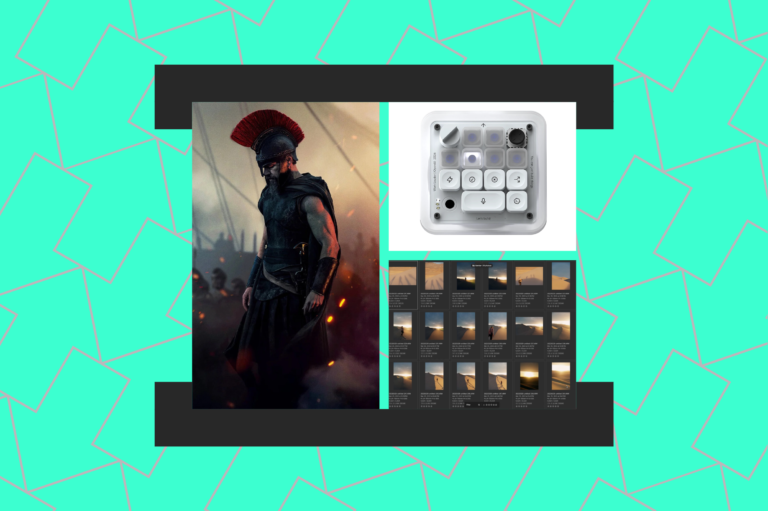
Adobe’s experimental camera app has taken an unexpected turn. After Project Indigo was launched last year to provide a “more natural (SLR-like) look” for iPhone photography, the Indigo camera app is now being updated with a suite of generative AI tools. And the change doesn’t rely upon Adobe’s own Firefly AI models. Adobe describes the […]

Read More »

Risk Management: Cyber Security

As AI supercharges cyber threats, organisations face multiple challenges: a new breed of reckless western hackers trying to impress their peers; fake remote workers attacking from the inside; and supply-chain weaknesses

Read More »

AI is more likely than humans to form biases when hiring

The next time you apply for a job, AI may screen your résumé before any human sees it. But there’s good reason to question whether AI will judge you fairly. Researchers already know that LLMs pick up human biases from their training data. New research suggests that LLMs can also develop their own biases from…

Read More »

Kimi K3 open-weight model: China’s biggest AI is a bet on memory, not compute

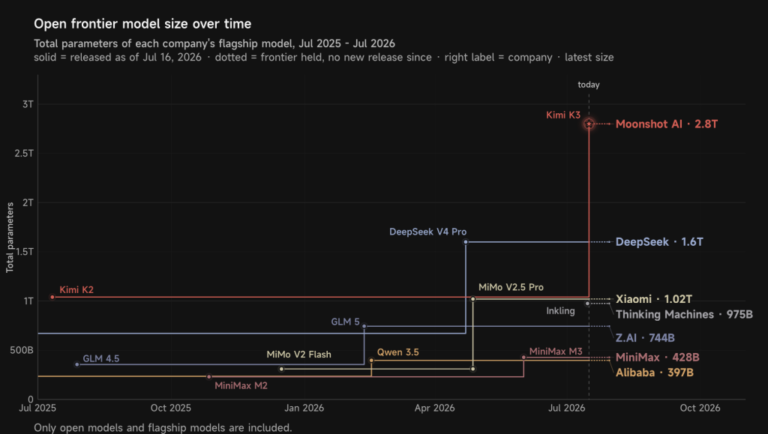
Moonshot AI’s Kimi K3 open-weight model has been read almost entirely through its parameter count since it launchedon July 16. At 2.8 trillion parameters, it is the largest open-weight model released to date. Model sizes are usually grouped into rough brackets, and 2.8 trillion rounds into what the industry calls the 3T class. A tier no […]

The post Kimi K3 open-weight model: China’s biggest AI is a bet on memory, not compute appeared first on AI News.

Read More »

US public health agencies to test OpenAI and Anthropic AI models

Public health departments across the United States will test generative AI tools under a new programme involving the Coalition for Health AI, OpenAI, Anthropic, and Accenture. The Public Health Use Case and Learning Scaling Engine, known as PULSE, will support trials in 10 state, local, tribal, or territorial jurisdictions. The programme is intended to produce […]

The post US public health agencies to test OpenAI and Anthropic AI models appeared first on AI News.

Read More »

Best Local LLMs You Can Run on a Single 24GB GPU in 2026: Qwen, Gemma, Mistral, DeepSeek Compared

A single 24GB GPU is the practical floor for serious local inference. This guide compares six open-weight models that fit one card at Q4_K_M. It covers Qwen3.6, Gemma 4, Mistral Small, gpt-oss-20b, and DeepSeek-R1-Distill. Each entry lists VRAM fit, licensing, and the job it does best.

The post Best Local LLMs You Can Run on a Single 24GB GPU in 2026: Qwen, Gemma, Mistral, DeepSeek Compared appeared first on MarkTechPost.

Read More »

Someone Fine-Tuned OpenBMB’s MiniCPM5-1B on Claude Fable 5 Traces to Ship a 657MB Local Thinking Model

A community developer fine-tuned OpenBMB’s MiniCPM5-1B on Claude Fable 5 traces into a 1B model that runs fully local — a 657MB smallest build, 128K context, and visible reasoning. We verify every spec against the Hugging Face cards, separate what a fine-tune actually inherits from real capability, and flag the licensing question the model card leaves open.

The post Someone Fine-Tuned OpenBMB’s MiniCPM5-1B on Claude Fable 5 Traces to Ship a 657MB Local Thinking Model appeared first on MarkTechPost.

Read More »

Alibaba Previews Qwen3.8-Max, a 2.4 Trillion-Parameter Multimodal Model, Days After Moonshot’s Kimi K3 Open-Weight Launch

Alibaba’s Qwen team previewed Qwen3.8-Max-Preview, a 2.4 trillion-parameter multimodal MoE model it calls “second only to Fable 5.” The preview is live on Token Plan, Qoder, and QoderWork at 10% of standard pricing. What is not live: any benchmark table, model card, license, per-token price, or active-parameter count. This breakdown separates what Alibaba confirmed from what it only claimed.

The post Alibaba Previews Qwen3.8-Max, a 2.4 Trillion-Parameter Multimodal Model, Days After Moonshot’s Kimi K3 Open-Weight Launch appeared first on MarkTechPost.

Read More »

Feyn AI Releases SQRL, a Text-to-SQL Model Family That Inspects the Database Before Writing a Query

Feyn Labs has released SQRL, a family of text-to-SQL models that inspect a database with read-only probes before committing to a query. The flagship SQRL-35B-A3B reports 70.6% execution accuracy on BIRD Dev, edging Claude Opus 4.6, and distills into self-hostable 4B and 9B checkpoints.

The post Feyn AI Releases SQRL, a Text-to-SQL Model Family That Inspects the Database Before Writing a Query appeared first on MarkTechPost.

Read More »

I hate that I don’t hate this song made with Suno

I would never go so far as to say there’s no place for AI in music (I’m a fan of Holly Herndon, after all). But I generally find music made with generative AI to be offensively boring, especially the outputs of Suno. So I’m having a bit of a tough time processing the fact that […]

Read More »

Fine-Tuning Qwen3 with LoRA Using NVIDIA NeMo AutoModel: A Complete Single-GPU Google Colab Workflow Tutorial

We build an end-to-end NVIDIA NeMo AutoModel workflow in Google Colab using a single GPU. We verify CUDA hardware and precision support, install NeMo AutoModel from source, and load an official Qwen3-0.6B LoRA recipe. We then adapt its precision, batch size, checkpointing, and scheduler settings for a constrained runtime. We launch fine-tuning through the automodel CLI, reload the LoRA checkpoint, and compare base versus fine-tuned outputs. We finish with the NeMoAutoModelForCausalLM Python API.

The post Fine-Tuning Qwen3 with LoRA Using NVIDIA NeMo AutoModel: A Complete Single-GPU Google Colab Workflow Tutorial appeared first on MarkTechPost.

Read More »

Perplexity AI Releases WANDR: An Open Benchmark Evaluating Research Agents That Must Search Wide And Deep

Perplexity’s WANDR is an open benchmark and evaluation harness with 500 evidence-heavy tasks. It tests whether research agents can discover many qualifying entities and back each one with cited, re-verifiable evidence. Perplexity Search as Code leads at 0.363 soft F1 and 0.133 hard F1.

The post Perplexity AI Releases WANDR: An Open Benchmark Evaluating Research Agents That Must Search Wide And Deep appeared first on MarkTechPost.

Read More »

NVIDIA Released DeepStream 9.1: Bringing Agentic AI to Vision AI With 13 Skills and Multi-View 3D Tracking

NVIDIA DeepStream 9.1 introduces 13 agentic skills that let coding agents like Claude Code and Codex build multi-camera video analytics pipelines from natural-language prompts. Multi-View 3D Tracking (MV3DT) fuses per-camera detections into one shared 3D world with a globally consistent object ID, while AutoMagicCalib (AMC) removes manual camera calibration. The release also adds JetPack 7.2 support and a unified open-source GitHub monorepo.

The post NVIDIA Released DeepStream 9.1: Bringing Agentic AI to Vision AI With 13 Skills and Multi-View 3D Tracking appeared first on MarkTechPost.

Read More »

The apps, gadgets, and tools every reader needs

Hi, friends! Welcome to Installer No. 136, your guide to the best and Verge-iest stuff in the world. (If you’re new here, welcome, hope your neighborhood isn’t as smoky as mine, and also you can read all the old editions at the Installer homepage.) This week, I’ve been recording the next season of Version History […]

Read More »

Zyphra Releases ZUNA1.1: An Apache 2.0 EEG Foundation Model With Variable-Length Inputs From 0.5 To 30 Seconds

Zyphra released ZUNA1.1 on July 16, 2026, under the Apache 2.0 license. The 380M masked diffusion autoencoder reconstructs, denoises, and upsamples scalp-EEG across arbitrary channel layouts. It accepts variable-length inputs from 0.5 to 30 seconds, against ZUNA1’s fixed five seconds. Reported NMSE holds or improves while the input range widens.

The post Zyphra Releases ZUNA1.1: An Apache 2.0 EEG Foundation Model With Variable-Length Inputs From 0.5 To 30 Seconds appeared first on MarkTechPost.

Read More »

Build an Agentic Event Venue Operator with MongoDB Atlas, Voyage, and LangGraph

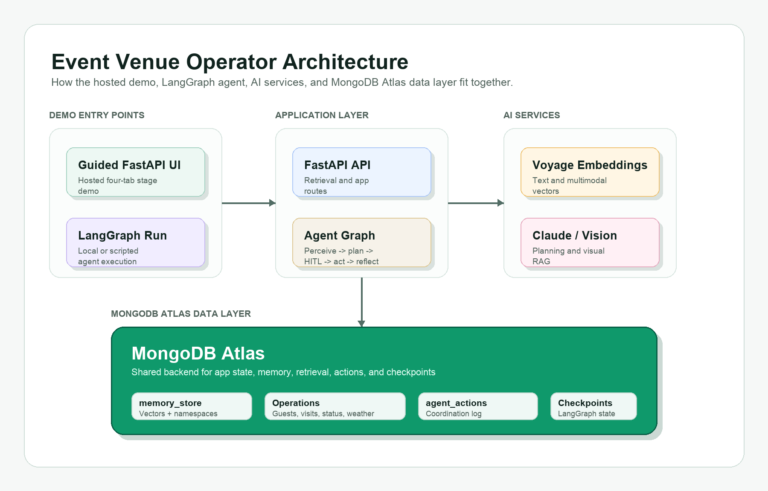
Introduction This tutorial starts where most agent demos stop: giving the agent persistent memory, operational context, and a place to write back what happened. An event operator does not just need an agent that can summarize a weather report or generate a generic plan. The operator needs an agent that can remember what happened at […]

The post Build an Agentic Event Venue Operator with MongoDB Atlas, Voyage, and LangGraph appeared first on MarkTechPost.

Read More »