
AI News

Unsloth vs Axolotl vs TRL vs LLaMA-Factory: A Fine-Tuning Framework Comparison on Speed, VRAM, and Multi-GPU

Four open source projects dominate LLM fine-tuning today. Unsloth, Axolotl, TRL, and LLaMA-Factory all wrap the same underlying PyTorch and Hugging Face stack. They diverge on where they spend engineering effort. Unsloth rewrites kernels. Axolotl composes parallelism strategies. TRL defines the trainer APIs the others build on. LLaMA-Factory optimizes for breadth of model coverage and […]

The post Unsloth vs Axolotl vs TRL vs LLaMA-Factory: A Fine-Tuning Framework Comparison on Speed, VRAM, and Multi-GPU appeared first on MarkTechPost.

Read More »

Substack adds an AI detector to help spot blogs written by no one

Substack will now help users determine whether what they’re reading may have been written by AI. A new tool coming to the platform can scan posts, notes, replies, and comments to provide an estimate of how much text could be AI-generated or written with AI assistance, according to a blog post published on Tuesday. The […]

Read More »

OpenAI says it accidentally hacked Hugging Face with a new AI system

OpenAI says its AI models mistakenly breached open-source AI platform Hugging Face during internal testing. In a blog post on Tuesday, OpenAI writes that GPT-5.6 Sol and “an even more capable pre-release model” discovered vulnerabilities within their sandboxed testing environment, allowing them to gain access to the internet and target Hugging Face. On July 16th, […]

Read More »

Neill Blomkamp’s new zombie AI ‘film’ is just slop warmed over

On Monday, District 9 and Gran Turismo director Neill Blomkamp unveiled his latest project: a 13-minute sci-fi short titled Nightborne that’s loosely based on Peter Watts’ 2014 novel Echopraxia. The short comes from Blomkamp’s new AI startup / production company, Barley Studios, and features characters whose voices and faces are modeled after human actors. But […]

Read More »

AI and the rise of the universal entertainment app

Over the past decade, streaming platforms competed by dominating individual formats like music, video, podcasts, or audiobooks. Now, as AI makes it easier to create, organize, and recommend content, those distinctions are fading, pushing companies like Spotify, Netflix, YouTube, and TikTok to become all-purpose entertainment destinations instead.

Read More »

The AI Slot Machine Effect: Why Generative Feeds Disrupt Deep Work And How to Reclaim Focus

You open a generative AI tool expecting a quick boost. Ten minutes later, you’re still there, refining a prompt for the fourth time. The task you started with has drifted off to the side somewhere. Sound familiar? Knowledge workers in 2026 are running into this more and more. It makes sense once you look at […]

The post The AI Slot Machine Effect: Why Generative Feeds Disrupt Deep Work And How to Reclaim Focus appeared first on AI News.

Read More »

Google’s Gemini 3.6 Flash targets enterprise agent token costs

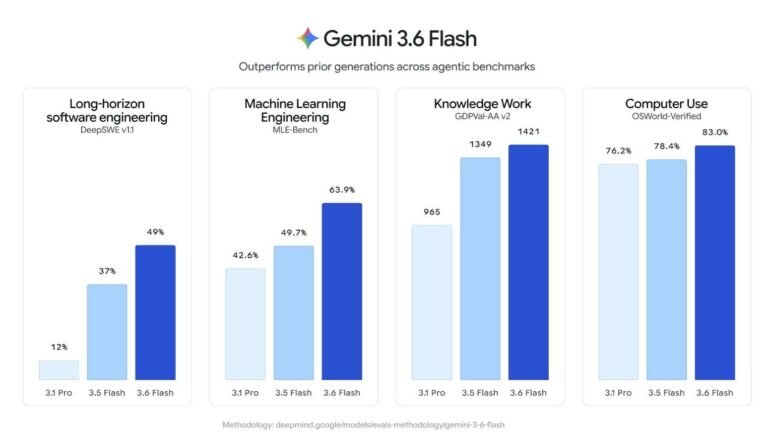
Google has released Gemini 3.6 Flash and 3.5 Flash-Lite as new workhorses designed to cut latency and token costs for enterprise AI agents. The economics of running autonomous software agents inside a production environment come down to a fixed equation few vendors advertise directly. A model needs to reason through a multi-step task competently, but […]

The post Google’s Gemini 3.6 Flash targets enterprise agent token costs appeared first on AI News.

Read More »

Validating Distributed LLM Serving Benchmarks with NVIDIA srt-slurm, SLURM Recipes, Parameter Sweeps, and Pareto Analysis

In this tutorial, we explore NVIDIA’s srt-slurm framework and learn how we use srtctl to convert declarative YAML configurations into reproducible SLURM benchmark workflows for distributed LLM serving. We set up the project in Google Colab, inspect its internal architecture, define a cluster configuration, dry-run built-in and custom recipes, and model a disaggregated prefill-and-decode deployment […]

The post Validating Distributed LLM Serving Benchmarks with NVIDIA srt-slurm, SLURM Recipes, Parameter Sweeps, and Pareto Analysis appeared first on MarkTechPost.

Read More »

Google Releases Gemini 3.6 Flash, 3.5 Flash-Lite, and 3.5 Flash Cyber: A Cheaper, More Token-Efficient Flash Tier Built for Agentic Workloads

Google released Gemini 3.6 Flash, 3.5 Flash-Lite, and 3.5 Flash Cyber on July 21, 2026. The Flash tier gets cheaper and more token-efficient, with 3.6 Flash cutting output tokens 17% and dropping its output price to $7.50 per 1M. Flash-Lite runs at 350 tokens/sec, while gated Flash Cyber powers CodeMender for vulnerability finding. The flagship 3.5 Pro remains delayed.

The post Google Releases Gemini 3.6 Flash, 3.5 Flash-Lite, and 3.5 Flash Cyber: A Cheaper, More Token-Efficient Flash Tier Built for Agentic Workloads appeared first on MarkTechPost.
Read More »

America needs to stop getting shocked by Chinese AI

Last week, two Chinese AI companies unveiled models they say can credibly compete with the best systems from OpenAI and Anthropic. The response was swift and predictable. Markets wobbled, commentators declared Silicon Valley shooketh, and policymakers reached for the familiar language of arms races and wake-up calls. In one headline, The Associated Press said a […]

Read More »

Halliday’s latest smart glasses feature a much-improved display

I first slipped on Halliday’s original smart glasses at CES 2025. I was not a fan. The glasses had a tiny, movable display window embedded into the frame that was incredibly finicky to see, and my 30-minute demo left me with achy eyeballs. It was an interesting concept with terrible execution, especially compared to the […]

Read More »

Google launches a cheaper alternative to large AI security models like Mythos

Google is launching Gemini 3.6 Flash alongside a new security model dedicated to quickly finding and patching security vulnerabilities. In a blog post on Tuesday, Google describes Gemini 3.5 Flash Cyber as a “cost-efficient and highly capable alternative” to larger, more expensive AI systems, such as the one offered by Anthropic’s Mythos. The cybersecurity model […]

Read More »

Anthropic’s $1.5 billion book piracy settlement approved by judge

A federal judge has signed off on Anthropic’s $1.5 billion class action settlement with authors who accused the company of training its AI models on copyrighted books, as reported earlier by Reuters. In an order on Monday, Judge Araceli Martínez-Olguín writes that the settlement will provide “meaningful relief,” offering authors around $3,000 for each book […]

Read More »