
AI News

I checked out one of the biggest anti-AI protests ever

Pull the plug! Pull the plug! Stop the slop! Stop the slop! For a few hours this Saturday, February 28, I watched as a couple of hundred anti-AI protesters marched through London’s King’s Cross tech hub, home to the UK headquarters of OpenAI, Meta, and Google DeepMind, chanting slogans and waving signs. The march was…

Read More »

OpenAI’s “compromise” with the Pentagon is what Anthropic feared

On February 28, OpenAI announced it had reached a deal that will allow the US military to use its technologies in classified settings. CEO Sam Altman said the negotiations, which the company began pursuing only after the Pentagon’s public reprimand of Anthropic, were “definitely rushed.” In its announcements, OpenAI took great pains to say that…

Read More »

MWC 2026: SK Telecom lays out plan to rebuild its core around AI

At MWC 2026 in Barcelona, SK Telecom outlined how it is rebuilding itself around AI, from its network core to its customer service desks. The shift goes beyond adding new AI tools. It involves rewriting internal systems, expanding data centre capacity to the gigawatt scale, and upgrading its own large language model to more than […]

The post MWC 2026: SK Telecom lays out plan to rebuild its core around AI appeared first on AI News.

Read More »

AI adoption in financial services has hit a point of no return

AI adoption in financial services has effectively become universal–and the institutions still treating it as an experiment are now the outliers. According to Finastra’s Financial Services State of the Nation 2026 report, which surveyed 1,509 senior executives across 11 markets, only 2% of financial institutions globally report no use of AI whatsoever.  The debate is […]

The post AI adoption in financial services has hit a point of no return appeared first on AI News.

Read More »

Meet NullClaw: The 678 KB Zig AI Agent Framework Running on 1 MB RAM and Booting in Two Milliseconds

In the current AI landscape, agentic frameworks typically rely on high-level managed languages like Python or Go. While these ecosystems offer extensive libraries, they introduce significant overhead through runtimes, virtual machines, and garbage collectors. NullClaw is a project that diverges from this trend, implementing a full-stack AI agent framework entirely in Raw Zig. By eliminating […]

The post Meet NullClaw: The 678 KB Zig AI Agent Framework Running on 1 MB RAM and Booting in Two Milliseconds appeared first on MarkTechPost.

Read More »

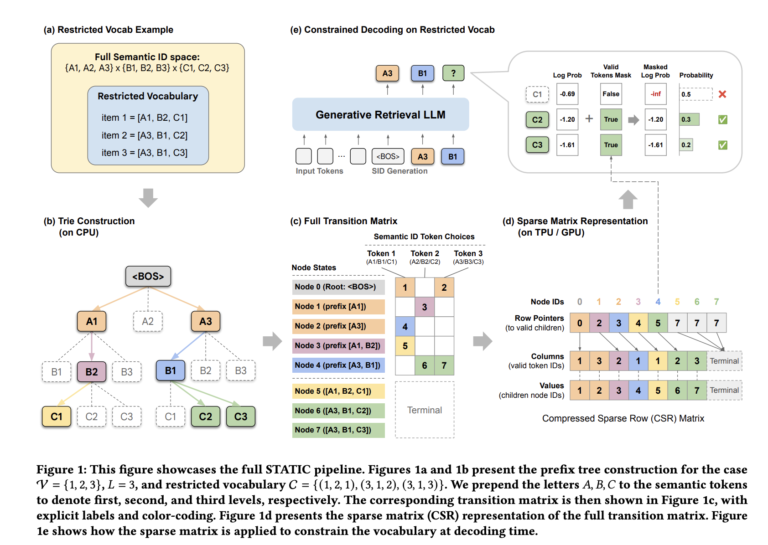
Google AI Introduces STATIC: A Sparse Matrix Framework Delivering 948x Faster Constrained Decoding for LLM Based Generative Retrieval

In industrial recommendation systems, the shift toward Generative Retrieval (GR) is replacing traditional embedding-based nearest neighbor search with Large Language Models (LLMs). These models represent items as Semantic IDs (SIDs)—discrete token sequences—and treat retrieval as an autoregressive decoding task. However, industrial applications often require strict adherence to business logic, such as enforcing content freshness or […]

The post Google AI Introduces STATIC: A Sparse Matrix Framework Delivering 948x Faster Constrained Decoding for LLM Based Generative Retrieval appeared first on MarkTechPost.

Read More »

How to Build an Explainable AI Analysis Pipeline Using SHAP-IQ to Understand Feature Importance, Interaction Effects, and Model Decision Breakdown

In this tutorial, we build an advanced explainable AI analysis pipeline using SHAP-IQ to understand both feature importance and interaction effects directly inside our Python environment. We load a real-world dataset, train a high-performance Random Forest model, and then apply the SHAP-IQ interaction index to compute precise, theoretically grounded explanations of model predictions. We extract […]

The post How to Build an Explainable AI Analysis Pipeline Using SHAP-IQ to Understand Feature Importance, Interaction Effects, and Model Decision Breakdown appeared first on MarkTechPost.

Read More »

FireRedTeam Releases FireRed-OCR-2B Utilizing GRPO to Solve Structural Hallucinations in Tables and LaTeX for Software Developers

Document digitization has long been a multi-stage problem: first detect the layout, then extract the text, and finally try to reconstruct the structure. For Large Vision-Language Models (LVLMs), this often leads to ‘structural hallucinations’—disordered rows, invented formulas, or unclosed syntax. The FireRedTeam has released FireRed-OCR-2B, a flagship model designed to treat document parsing as a […]

The post FireRedTeam Releases FireRed-OCR-2B Utilizing GRPO to Solve Structural Hallucinations in Tables and LaTeX for Software Developers appeared first on MarkTechPost.

Read More »

A Complete End-to-End Coding Guide to MLflow Experiment Tracking, Hyperparameter Optimization, Model Evaluation, and Live Model Deployment

In this tutorial, we build a complete, production-grade ML experimentation and deployment workflow using MLflow. We start by launching a dedicated MLflow Tracking Server with a structured backend and artifact store, enabling us to track experiments in a scalable, reproducible manner. We then train multiple machine learning models using a nested hyperparameter sweep while automatically […]

The post A Complete End-to-End Coding Guide to MLflow Experiment Tracking, Hyperparameter Optimization, Model Evaluation, and Live Model Deployment appeared first on MarkTechPost.

Read More »

Alibaba Team Open-Sources CoPaw: A High-Performance Personal Agent Workstation for Developers to Scale Multi-Channel AI Workflows and Memory

As the industry moves from simple Large Language Model (LLM) inference toward autonomous agentic systems, the challenge for devs have shifted. It is no longer just about the model; it is about the environment in which that model operates. A team of researchers from Alibaba released CoPaw, an open-source framework designed to address this by […]

The post Alibaba Team Open-Sources CoPaw: A High-Performance Personal Agent Workstation for Developers to Scale Multi-Channel AI Workflows and Memory appeared first on MarkTechPost.

Read More »

How to Design a Production-Grade Multi-Agent Communication System Using LangGraph Structured Message Bus, ACP Logging, and Persistent Shared State Architecture

In this tutorial, we build an advanced multi-agent communication system using a structured message bus architecture powered by LangGraph and Pydantic. We define a strict ACP-style message schema that allows agents to communicate via a shared state rather than calling each other directly, enabling modularity, traceability, and production-grade orchestration. We implement three specialized agents, a […]

The post How to Design a Production-Grade Multi-Agent Communication System Using LangGraph Structured Message Bus, ACP Logging, and Persistent Shared State Architecture appeared first on MarkTechPost.

Read More »