AI News

Google Research Introduces SensorFM: A Wearable Health Foundation Model Pretrained on One Trillion Minutes of Sensor Data

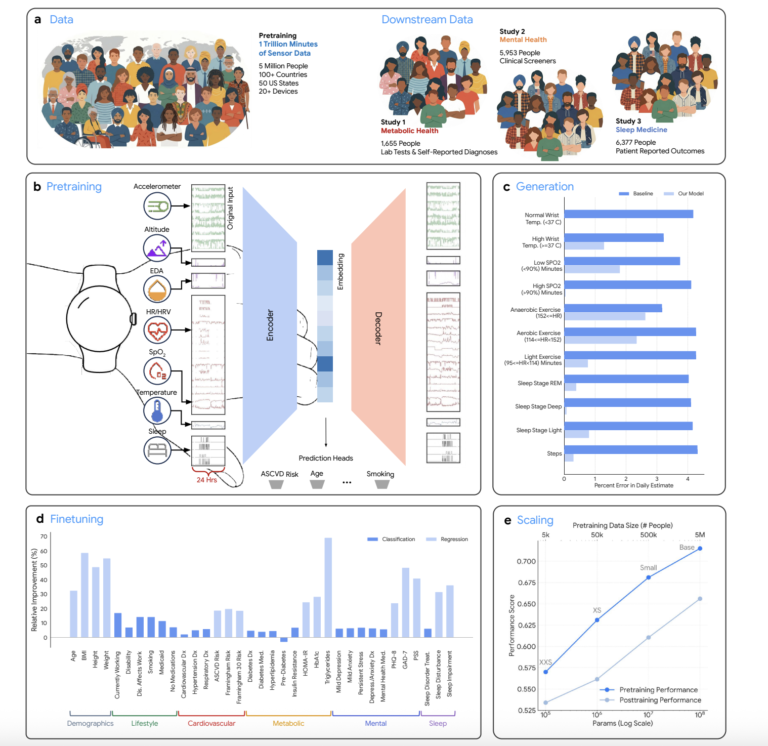
SensorFM, a wearable health foundation model from Google Research, Google DeepMind, and university collaborators. We walk through its ViT-1D masked-autoencoder backbone, pretrained on more than one trillion minutes of unlabeled sensor signals from 5,000,000 consented participants. We examine the co-scaling results across four model sizes and four data volumes, including the case where capacity outruns data. We show how frozen embeddings plus a PCA-50 linear probe beat feature-engineered baselines on 34 of 35 tasks. We also review the agentic classroom that searched 30,516 prediction heads, and the clinician evaluation grounding a Personal Health Agent.

The post Google Research Introduces SensorFM: A Wearable Health Foundation Model Pretrained on One Trillion Minutes of Sensor Data appeared first on MarkTechPost.


Read More »

Google will now tell you if an ad was made with AI

You can see if ads on Google Search, Google Discover, and YouTube were made or edited using AI from a new section in Google’s “My Ad Center,” as reported earlier by TechCrunch. The update, announced on Thursday, adds a “created or edited with AI” label under the “how this ad was made” tab. Users can […]

Read More »

The ChatGPT browser is already dead

OpenAI is already shutting down ChatGPT Atlas, its browser that could do tasks for you on your behalf, less than a year after launching it. Atlas was announced in October, but as part of its wave of news about ChatGPT Work today, the company confirmed that it will be “sunsetting” Atlas and is targeting an […]

Read More »

Microsoft’s carbon emissions went up 25 percent last year

Microsoft may once again be struggling to keep up with its own climate goals, according to its 2026 sustainability report. As reported by GeekWire, the report states that Microsoft’s carbon emissions increased 25 percent in 2025, totalling 34 million metric tons “without select interventions.” Microsoft says this was “driven primarily by the expansion of our […]

Read More »

Fidji Simo steps down from OpenAI’s no. 2 role

OpenAI’s No. 2 executive, Fidji Simo, is stepping down from her full-time role after her medical leave proved longer than expected — a leadership vacuum that comes at a tricky time as the company eyes a possible IPO and races to catch Anthropic in the enterprise market.

Read More »

AWS GraphRAG deployment cuts drug research cycles by 87%

A recent AWS GraphRAG deployment reduced drug research and development cycles in pharmaceutical environments by 87 percent. This acceleration is achieved by integrating previously separated proprietary databases into a unified and queryable knowledge graph. Historically, initial data gathering and screening phases took over six months per iteration, yielding a low five percent success rate. Crucial […]

The post AWS GraphRAG deployment cuts drug research cycles by 87% appeared first on AI News.

Read More »

OpenAI Releases GPT-5.6 (Sol, Terra, Luna): A Three-Tier Model Family With Programmatic Tool Calling in the Responses API

OpenAI moved GPT-5.6 to general availability on July 9, 2026, shipping three tiers instead of one model. Sol is $5/$30 per 1M tokens, Terra is $2.50/$15, and Luna is $1/$6. Sol sets the Artificial Analysis Coding Agent Index at 80, 2.8 points above Claude Fable 5, and reaches 62.6% on OSWorld 2.0 using 85% fewer output tokens than Opus 4.8. The substantive developer change is Programmatic Tool Calling, which runs model-written JavaScript in an isolated V8 runtime to orchestrate tools without returning every intermediate result to the model. Clio reports a 38% cut in prompt tokens, PlayCo 63.5% fewer total tokens. The gaps are real too: Fable 5 still leads the Artificial Analysis Intelligence Index, GDPval-AA v2, and Toolathlon, and Claude Mythos 5 leads SWE-Bench Pro by roughly 15 points.

The post OpenAI Releases GPT-5.6 (Sol, Terra, Luna): A Three-Tier Model Family With Programmatic Tool Calling in the Responses API appeared first on MarkTechPost.
Read More »

Meta Superintelligence Labs Releases Muse Spark 1.1: A Multimodal Reasoning Model for Agentic Tasks on Meta Model API

Meta Superintelligence Labs released Muse Spark 1.1 on July 9, 2026, alongside a public preview of the Meta Model API. It is a multimodal reasoning model built for agentic tasks, with a 1,000,000-token context window the model actively compacts, zero-shot generalization to new tools and MCP servers, and multi-agent delegation across parallel subagents. Meta’s own launch table shows it leading tool use while trailing Opus 4.8 and GPT-5.5 on coding.

The post Meta Superintelligence Labs Releases Muse Spark 1.1: A Multimodal Reasoning Model for Agentic Tasks on Meta Model API appeared first on MarkTechPost.

Read More »

Character.AI wants a piece of the microdrama pie

Character.AI’s plan to become more than just an LLM-powered chatbot platform is going beyond interactive books, comics, and audio dramas. Today, the company announced the debut of c.ai Series – short-form, episodic videos designed to be watched and interacted with – on your phone. Unlike traditional microdrama services that feature cheaply produced, live-action shows starring […]

Read More »

Say hello to Claude Wrapped

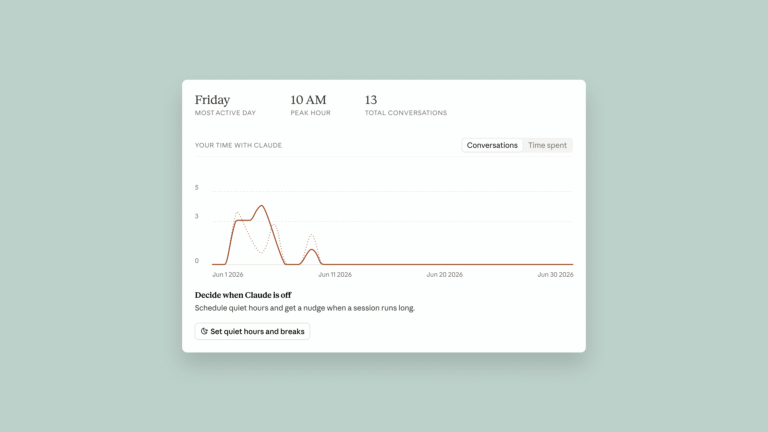
The popularity of Spotify Wrapped has kicked off a wide range of year-in-review features, on apps from YouTube to Uber – and now, the lookback trend has come to AI. Anthropic on Thursday announced a “reflect” feature for its Claude chatbot, allowing users to see an analysis of their usage data over the past month, […]

Read More »

Meta says its new AI model is ready to compete on coding

After reentering the AI race with its first in-house Muse Spark model in April, Meta is now opening up the doors to developers with a new model that can plug into AI coding software with the new Meta Model API. Meta says that Muse Spark 1.1 is a “step-change” from the first generation, with improvements […]

Read More »