
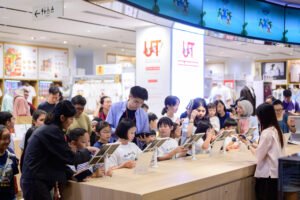
Walk into UNIQLO’s Orchard Central Global Flagship Store on a weekend, and you might find a group of children learning how to fold T-shirts with military precision—competing, laughing, and walking away with a custom-designed tee they made themselves. It is not a school field trip; it is an investment in the future of one of the world’s most ambitious retail brands.
This is UNIQLO Singapore’s Kids Camp, a hands-on program for children aged 6 to 12 that introduces participants to store operations, clothing vocabulary and even design through the brand’s UTme! personalization service. As playful as it sounds, it is the opening chapter of what the organization describes as a cradle-to-career talent ecosystem—one designed to engage young people long before they ever consider submitting a job application.
For Juliana Tan, UNIQLO Singapore’s Human Resources Director, the logic is straightforward. “From early exposure initiatives like UNIQLO Kids Camp to diverse career pathways like the Global Management Programme, Global Internship Programme, and UNIQLO Management Candidate programme, our ecosystem of programmes reflects the mindset of grooming employees with a global mindset—ready to serve a global audience of customers,” she said.
See also: Redesigning EX for 2023? Put purpose at the center of your plan
Rethinking the talent funnel at UNIQLO
The retail industry has long struggled with the question of how to attract and retain quality talent. High street brands compete not just on product, but increasingly on employee value proposition, and the war for talent among Gen Z and Gen Alpha candidates is only intensifying.

UNIQLO’s answer is to start early. Beyond Kids Camp, the organisation runs Kids in Action and Planet POV—programmes aimed at primary and secondary school students that weave sustainability and responsible consumption into interactive experiences, such as clothing-recycling workshops and beach clean-ups. These are not peripheral CSR activities. They are, by Tan’s account, the foundation of a long-term brand affinity strategy.
“For younger participants, initiatives like Kids Camp introduce foundational values such as teamwork, responsibility and creativity through hands-on experiences in a real store environment,” Tan explains. “These early touchpoints help shape not just awareness, but a sense of purpose and alignment with UNIQLO’s values.”
The results suggest this is more than feel-good programming. UNIQLO Singapore has seen a 55% increase in applications to its UNIQLO Management Candidate (UMC) programme between 2025 and 2026, alongside what Tan describes as improved candidate preparedness during interviews. In January 2026, the brand was ranked the most considered fashion brand in the YouGov Awards, a recognition that reflects both consumer and talent market positioning.
For those progressing into tertiary education and early careers, UNIQLO has constructed a multi-rung ladder of structured entry pathways. The Local Store Internship (GIP), piloted in December 2025, provides university students with hands-on shop floor experience. High-potential candidates can then transition into the UMC program—notably open to graduates from any academic background, including those without prior retail or business experience.
At the apex sits the Global Management Programme (GMP), a six-day intensive experience in Tokyo where participants interact directly with global business leaders and gain exposure to the inner workings of one of the world’s most recognized fashion brands.
“With various internships and global programs, UNIQLO is looking to attract ambitious individuals who have high potential to be their very own business leaders, regardless of their nationality, ethnicity, gender and age,” Tan says. “Only with a culture of inclusiveness can we truly learn from each other and continuously innovate the business for our customers.”
This deliberate openness reflects UNIQLO’s Made for All philosophy, a principle that guides not just product design, but also how the organisation builds its workforce. Just as LifeWear is designed to transcend demographics, UNIQLO’s talent strategy is built to draw from the widest possible pool of human potential. “To truly serve a very large and diverse population of global customers, our workforce similarly needs to have a diverse group of people,” Tan notes.
The retention equation
In an era when quiet quitting and lateral job-hopping define the employee experience in retail, UNIQLO’s early engagement strategy also serves as a retention mechanism. The theory is that candidates who develop brand affinity before they enter the workforce arrive with a stronger sense of alignment and are more likely to grow with the organization over time.
Tan frames this through the lens of UNIQLO’s Global One and ZEN-IN KEIEI management philosophy, which calls for all employees worldwide to develop a global perspective and adopt a business leader mindset regardless of their role. “By providing non-linear career pathways and continuous development opportunities, employees are empowered to grow with the organization over the long term,” she says. “This approach enables us to build business leaders who can bring diverse insights back to strengthen the local business.”
The non-linear emphasis matters. Rather than funneling talent through a single, rigid pipeline, UNIQLO offers multiple points of entry and lateral movement, a structure that appeals particularly to younger employees who place high value on autonomy, learning, and progression on their own terms.
Perhaps the most telling indicator of where UNIQLO’s talent strategy is headed lies in its integration of sustainability into its employee value proposition. As Gen Z and Gen Alpha candidates increasingly evaluate prospective employers on social and environmental impact —often placing it above compensation—the brands that embed purpose into their daily operations stand to attract the most mission-driven talent.
This is not new territory for the brand. “At UNIQLO, sustainability is not just a trend—it is deeply embedded into our business model as our approach to creating truly good clothing, while being committed to respecting human rights and contributing positively to the communities we operate in,” Tan says.
The organization’s LifeWear philosophy—positioning apparel as essential, long-lasting, and high-quality—is articulated internally as “A New Industry” model. Circularity efforts, responsible production and supply chain sustainability are not just marketing pillars; they are, in Tan’s telling, part of what makes a career at UNIQLO meaningful. That message is reinforced by UNIQLO Singapore’s recent designation as a Champion of Good by the National Volunteer and Philanthropy Centre (NVPC), the highest tier of recognition for corporate purpose in Singapore, and a first for the brand.
The long view
UNIQLO has been in Singapore since 2009, and its talent ambitions have grown in step with its commercial footprint. The brand now ranks 47th on Interbrand’s Best Global Brands 2025 list—its highest-ever position—a milestone Tan attributes, in no small part, to its people strategy.
“Our people are key to achieving a globally proficient workforce with similar values and aspirations to serve society well,” she says.
In an industry where the transactional employment relationship remains stubbornly dominant, UNIQLO Singapore’s approach represents a meaningful departure. By investing in young people—as children, as students, and as emerging professionals—the organisation is not just filling vacancies; it is cultivating a generation of employees who arrive at the door already believing in what the brand stands for.
In a tight talent market, that head start may be worth more than any signing bonus.
The post The philosophy driving UNIQLO’s HR strategy: Made for all, hired from all appeared first on HR Executive.
This article was originally published on HR Executive. Click below to read the complete article.