
Workforce agility is now an explicit priority in many organizations. Leaders want faster reskilling, faster redeployment and more responsive workforce planning as strategy evolves. Yet, HR—the function charged with enabling that agility—cannot always shift its own focus when priorities change.
The result is a gap between the agility the business expects and what HR can consistently deliver. Closing that gap requires HR leaders to understand the conditions that make shifting focus difficult as well as the practical strategies that strengthen speed and responsiveness.
See also: Why most organizations struggle to build agility for an AI-driven future
HR’s capacity to shift focus
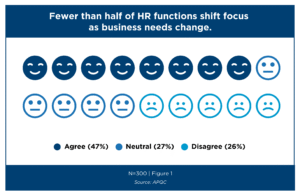
When we asked HR leaders whether their function can shift focus as business needs change, fewer than half agreed (47%). The rest were split evenly: Roughly a quarter (26%) disagreed that they can shift focus, and another 27% did not agree or disagree.

This is not a question of commitment. HR teams are already absorbing significant volatility—supporting reskilling, workforce redesign and AI-enabled change while also sustaining daily operations that do not slow down when new demands arrive. Instead, the data reflects constraints in how HR work is organized and resourced.
When HR cannot reliably shift focus, operational constraints like fully committed capacity, specialized roles with tight swim lanes and planning cycles that lag emerging needs are often at play. In these conditions, work does not move easily across teams and priorities are difficult to reset.
The data suggests that organizations are pursuing agility, while the function expected to orchestrate it does not consistently experience it internally. That tension points to a tradeoff many HR teams are making, often without naming it.
The hidden tradeoff
In response to expectations for greater business agility, HR often defers investment in its own ability to shift focus. This decision is rooted in an understandable assumption: The business must come first, and improvements inside the function can wait.
Over time, that assumption hardens into a tradeoff. Organizations prioritize broader workforce agility while leaving HR’s own capacity, structure and ways of working largely unchanged. As a result of this tradeoff, HR is expected to move quickly while operating within structures that are designed for consistency and control.
The cost of the tradeoff: Time, drag and fragility
When HR cannot easily shift focus, workforce initiatives take longer to deliver. Reskilling programs ramp more slowly, redeployment decisions stall and workforce plans require repeated revisions as assumptions expire. Initiatives may pause and restart as priorities shift, creating rework and eroding momentum.
When it operates in a constant state of reactivity, HR has little room to invest in its own skill development, process modernization or professional growth. Over time, that creates a capability gap inside the function, increasing dependence on a small group of overextended leaders.
Why this problem persists
Most HR capacity is already committed to recurring operational work like managing compliance, processing payroll, recruiting new talent and administering benefits. There is little unassigned capacity sitting on the bench.
Role specialization in HR builds expertise but makes it harder to shift work across teams when priorities change. Moving an initiative from one group to another may require new approvals, new funding conversations or new reporting lines.
Governance mechanisms further reinforce stability. Approval processes, risk reviews and budget checkpoints are designed to prevent errors and ensure consistency. They are not typically built for rapid reprioritization when business conditions suddenly shift.
These structures reflect reasonable efforts to deliver reliability and control. Taken together, however, they make it difficult for HR to reallocate effort quickly when business needs change, constraining enterprise agility as well.
Where to begin with workforce agility
Workforce decisions move through HR. When HR has visibility into its own capacity, clarity about skills inside the function and mechanisms for reprioritizing work, it can execute those decisions more predictably. When that visibility and flexibility are absent, enterprise agility will suffer. Simply put: Strengthening HR’s ability to reallocate time, skills and attention is a prerequisite for enabling the same capability across the enterprise.
In practice, strengthening HR’s ability to shift focus often starts with a small set of deliberate interventions that make work more visible, more movable and easier to reprioritize.
Start small and make it repeatable
Leading HR teams put practical mechanisms in place to make their work more transparent and more flexible. Once those mechanisms are in place, the function is better positioned to drive workforce agility across the enterprise.
Four changes in particular tend to make a meaningful difference:
- Work visibility—Maintain a current, shared view of the initiatives and recurring work underway so leaders can see what is truly consuming capacity.
- Skill visibility—Clarify the capabilities inside HR beyond job titles so work can be aligned to skills, not just roles.
- Simple redeployment options—Create lightweight ways to shift people to priority work on a temporary basis without formal restructuring.
- Clear prioritization rules—Establish explicit guardrails for what pauses, what continues, and who decides when demands compete.
Together, these actions build HR’s ability to shift focus deliberately rather than reactively and create a foundation for enterprise workforce agility.
Why starting with HR makes business sense
When HR can reallocate its own time and skills with discipline, it demonstrates what sustainable agility looks like. Business leaders are more likely to support workforce mobility, reskilling, and reprioritization when they see those moves working inside the function responsible for orchestrating them. In turn, agility inside HR makes workforce shifts more practical and easier to execute.
The guidance below translates these principles into practical next steps.
Work visibility
Make HR work visible enough to move it.
- Create and maintain an inventory of current HR work (projects, initiatives, and recurring tasks), including business purpose and ownership.
- Categorize work as business critical, important but deferrable or nice to have.
- When priorities shift, review this inventory to identify what can pause, stop or be reassigned.
Skill visibility
Clarify capabilities beyond job titles.
- Identify the skills most critical to your current priorities (e.g., workforce planning, relationship building, process design).
- Use self-assessment or manager input to map those skills to specific people.
- Reassign work based on capabilities, not roles.
Simple redeployment options
Test movement before formal programs.
- Pilot short reassignments or surge teams to support priority work.
- Keep pilots small (think weeks, not months) and focus on learning what works.
- Treat early redeployments as opportunities to iterate and improve.
Clear prioritization rules
Reduce pause and restart cycles.
- Establish a simple set of rules for setting priorities when demands compete.
- Make the rules easy to access and provide training so people can apply them consistently.
These actions don’t eliminate constraints—but they make it possible for HR to shift focus deliberately, rather than relying on heroic effort when priorities change.
Data in this content was accurate at the time of publication. For the most current data, visit www.apqc.org.
The post Workforce agility starts with HR appeared first on HR Executive.
This article was originally published on HR Executive. Click below to read the complete article.